Credit Card Cancellation Impact Estimator
Current Credit Profile
Card to Cancel
Enter your details and click Calculate to see the estimated impact.
You stare at the annual fee notice. It’s $150 for a card you haven’t used in six months. The temptation to click "Cancel" is strong. But a nagging thought stops your finger: will closing this account tank my credit score? You’re not alone in worrying about this. Financial advisors often warn that closing cards can hurt your score, but they rarely explain exactly how much it hurts or when it actually matters.
Here is the blunt truth: cancelling a credit card can lower your credit score, but it doesn’t always happen, and the damage is usually temporary if you manage your remaining credit wisely. The impact depends entirely on two factors: how long you’ve held the card and how much debt you carry across all your accounts. If you have plenty of other open credit lines and low balances, closing one old card might barely move the needle. If you’re thin on credit history or maxed out elsewhere, it could sting more than you expect.
The Two Main Ways Closing a Card Hits Your Score
To understand the risk, you need to look at how credit scoring models calculate your number. While there are many variations, most major models (like FICO and VantageScore) weigh five key factors. Two of these are directly affected when you close an account.
Credit Utilization Ratio is the percentage of your available credit that you are currently using. This factor typically accounts for 30% of your score. When you close a card, you lose its credit limit from your total available pool. If your balance stays the same, your utilization percentage jumps up. For example, if you have $2,000 in debt spread across cards with a total limit of $10,000, your utilization is 20%. Close a card with a $5,000 limit, and your new total limit is $5,000. Now that same $2,000 debt represents 40% utilization. Higher utilization signals risk to lenders, which lowers your score.
Length of Credit History is a measure of how long your accounts have been open. This usually makes up 15% of your score. Scoring models look at the average age of your accounts and the age of your oldest account. Closing an old card doesn’t instantly erase its history from your report; positive information stays on your credit file for 10 years after closure. However, once those 10 years pass, the account drops off completely. If that was your oldest card, your average account age shrinks, potentially lowering your score. This is a slow-burn effect, not an immediate crash.
When It Is Safe to Cancel
Not every cancellation is a mistake. Sometimes, keeping a card costs you more money than it helps your score. Here are scenarios where pulling the trigger is usually safe:
- You have plenty of other open cards: If you have three or four active cards with healthy limits, losing one won’t spike your utilization significantly.
- The card has a high annual fee: Paying $200 a year for a perk you don’t use is bad financial hygiene. The score dip is often worth the cash savings.
- You are trying to curb spending: If having access to too much credit leads to impulse buys, cutting the line protects your bank balance and prevents future debt accumulation.
- The issuer offers a downgrade: Many banks allow you to switch a premium card to a no-fee version. This keeps the account open, preserving your credit history and utilization, while eliminating the cost.
When You Should Think Twice
There are specific situations where closing a card causes disproportionate harm. If you fall into these categories, consider keeping the account open, even if it means paying a small fee or putting a recurring subscription on it.
- You have a short credit history: If you’ve only had credit for less than two years, every month counts. Closing an older account reduces your average age quickly.
- You plan to apply for a mortgage soon: Lenders scrutinize stability. A sudden drop in score due to a closed account could affect your interest rate. Aim to keep your credit profile stable for at least six months before a major loan application.
- You carry balances on other cards: As mentioned, losing available credit increases your utilization ratio. If you’re already near 30% utilization on your remaining cards, closing another one could push you over the threshold that triggers score penalties.
- It’s your oldest account: Losing the anchor of your credit history has a larger negative impact than closing a newer card.

Australian Context: What Changes Down Under?
If you live in Australia, the rules differ slightly from the US system. Australian credit reporting agencies like Experian, Equifax, and Illion do not use the exact same "utilization" weighting as FICO scores in America. In Australia, the focus is heavily on repayment behavior and the number of applications (inquiries).
However, the concept of "credit capacity" still matters. Banks assess how much credit you have access to versus what you owe. Closing a card reduces your total credit capacity. If you then apply for a home loan, the lender sees less buffer. Additionally, if you close a card with a good repayment history, you lose a data point that demonstrates reliability. Still, the immediate "score shock" is generally less severe in Australia than in the US, provided you pay your bills on time.
Step-by-Step: How to Cancel Without Breaking Your Credit
If you decide the card must go, follow these steps to minimize the damage.
- Redeem rewards first: Once you cancel, you usually forfeit any unredeemed points or miles. Spend them on flights, gift cards, or statement credits before making the call.
- Pay off the balance: Ensure the balance is zero. Leaving a tiny residual balance can cause issues with the final settlement and may leave the account technically "open" longer than expected.
- Check for pending transactions: Some subscriptions or delayed charges might hit after you think you’ve closed the account. Wait until you see a final zero balance statement.
- Contact the issuer: Call customer service or use the secure message center. Ask specifically if they offer a product change to a no-fee card. If they do, take it. If not, proceed with closure.
- Get written confirmation: Request an email or letter stating the account is closed and the balance is zero. Keep this for your records in case of reporting errors later.
- Monitor your credit report: Check your report 30-60 days later to ensure the account shows as "Closed by Consumer" with a zero balance.
Alternatives to Cancellation
Before you cut the plastic, consider these middle-ground options:
| Option | Impact on Score | Cost | Best For |
|---|---|---|---|
| Downgrade to No-Fee Version | Minimal to None | $0 Annual Fee | Keeping history and utilization intact |
| Freeze Account | No Immediate Impact | Varies (some charge fees) | Preventing fraud while keeping line open |
| Keep Open & Use Rarely | Positive (keeps history alive) | Annual Fee | Those who want maximum score optimization |
| Close Completely | Negative (short-term) | $0 Ongoing Cost | Those overwhelmed by debt or fees |
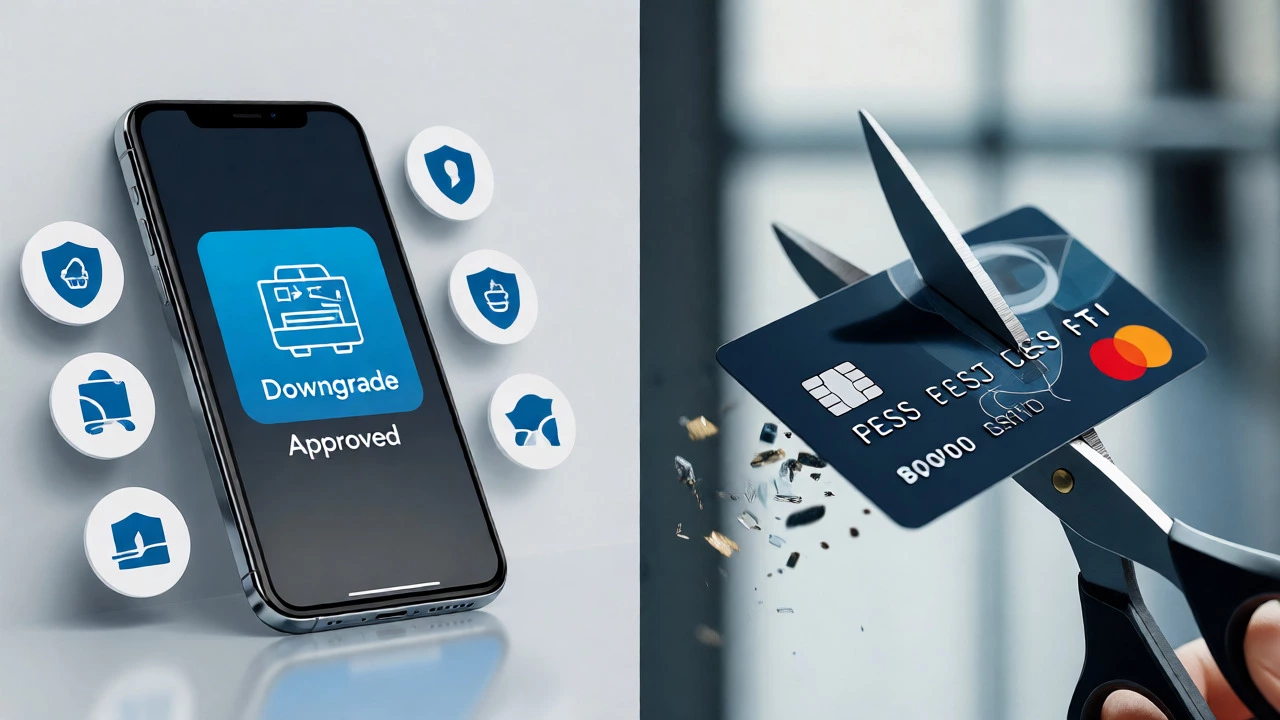
Downgrading is the gold standard. Most major issuers in Australia (like Commonwealth Bank, NAB, ANZ, and Westpac) and globally (Visa/Mastercard partners) allow you to swap a Gold or Platinum card for a basic version. You keep the account number, the opening date, and the credit limit. You just lose the lounge access or travel insurance. This is almost always better than closing.
Myths That Need Busting
Myth 1: Closing a card removes it from my report immediately. False. Positive accounts stay on your report for 10 years after closure. Negative accounts (late payments) stay for 7 years. So, closing a clean card doesn’t wipe out your history today.
Myth 2: Having too many open cards looks risky. Generally false. Lenders prefer borrowers who manage multiple lines of credit responsibly. Having ten cards with zero balances is seen as safer than having one maxed-out card. Only worry if you are actively applying for new credit and the inquiries pile up.
Myth 3: I need to keep using the card monthly to keep it open. Most issuers will close inactive accounts after 12-24 months. To prevent this, put a small recurring charge (like Netflix or Spotify) on the card and set up autopay. This keeps the account "active" without requiring effort.
Frequently Asked Questions
How much does my credit score drop when I close a card?
There is no fixed number. For most people, the drop ranges from 5 to 20 points. It depends on how much available credit you lose relative to your total debt. If you have a large credit portfolio, the impact might be negligible (0-5 points). If you have thin credit files, it could be higher.
Will closing a card affect my ability to get a home loan?
It can. Mortgage lenders look at your credit utilization and history. A sudden increase in utilization or a reduction in credit history length might flag you as slightly higher risk. It is best to avoid closing cards within 6 months of applying for a major loan.
Is it better to close a card or let the issuer close it?
It is generally better to close it yourself. When you initiate the closure, you control the timing and ensure the reason is recorded correctly. If the issuer closes it for inactivity, it might appear differently on some reports, though the impact is similar. Self-closing also ensures you redeem rewards first.
Do I lose my rewards points if I cancel?
Yes, in most cases. Points are tied to the account. Once the account is closed, unspent points are usually forfeited. Always check the terms and conditions and spend your points before initiating the closure process.
Can I reopen a cancelled credit card?
Sometimes. If you contact the issuer shortly after cancelling, they may reverse the decision. After several months, you likely have to reapply as a new customer, which involves a hard inquiry and loses your original account age.
Final Verdict
Don’t let fear paralyze you. If a card costs you money you don’t have, or causes stress because you’re tempted to overspend, close it. The temporary dip in your score is recoverable. Pay down your remaining balances, keep your other accounts in good standing, and your score will bounce back within a few billing cycles. Just remember: when in doubt, ask for a downgrade instead of a deletion. It’s the easiest win-win in personal finance.