
Cost of Capital Calculator
Standard rate is often 25% or 30% depending on company structure.
Long-Term Debt
Tax Deductible- Nominal Interest: 10%
- Tax Shield Benefit: -2.5%
- Annual Interest (Gross): ₹ 1.0 Lakh
- Net Cost to Firm: ₹ 0.75 Lakh
Equity / VC Funding
No Tax Benefit- Risk Premium: High
- Tax Deductible?: No
- Ownership Dilution: Yes
- Relative Cost vs Debt: +7.5%
Analysis
Based on your inputs, Debt is significantly cheaper than Equity. The tax deductibility of interest creates a "tax shield," reducing the effective cost of borrowing. For every ₹100 borrowed at 10%, you only pay ₹75 net after accounting for the tax savings. Equity investors demand higher returns because they bear more risk and receive no tax benefits from dividends.
Money isn't free. Every rupee you borrow or raise comes with a price tag, whether it's interest payments to a bank or giving up a slice of your company to an investor. For business owners and financial planners in India, finding the cheapest source of finance isn't just about saving money-it’s about maximizing profit margins and keeping the company alive during tight economic cycles.
If you are looking at the raw numbers, the answer might surprise you. It’s not usually the bank loan you’re thinking of. In most standard corporate structures in India, the absolute cheapest source of finance is Retained Earnings, which is profit that has been earned by the firm and kept within the business rather than distributed as dividends. Why? Because there are no transaction fees, no interest rates, and no dilution of ownership. However, this option only exists if your business is already profitable. If you need external cash, the hierarchy of costs changes dramatically.
The Hierarchy of Capital Costs in India
To understand what is cheap, you first need to understand how different sources of money are priced. In finance, we look at the "Cost of Capital." This is the return a company must earn on its existing body of capital to satisfy its creditors, owners, and other providers of capital. In the Indian context, these costs vary wildly based on regulation, risk perception, and market conditions.
Here is the general order from cheapest to most expensive:
- Retained Earnings: Zero direct cost. The opportunity cost is the return shareholders could have gotten elsewhere, but there is no cash outflow.
- Long-Term Debt (Bank Loans/Debentures): Interest is tax-deductible in India under Section 36(1)(iii) of the Income Tax Act, making the effective cost lower than the nominal rate.
- Prefixed Shares: Dividends are fixed but not tax-deductible for the company, making them more expensive than debt.
- Equity Shares (IPO/FV): Shareholders expect high returns because they take the highest risk. There are also significant issuance costs.
- Leasing/Hire Purchase: Often carries higher implicit interest rates compared to traditional term loans.
Let’s break down why debt often beats equity when you need outside money.
Why Debt is Usually Cheaper Than Equity
When you take a loan from a bank or issue debentures, you are paying interest. When you issue shares, you are promising future profits (dividends) and growth (capital appreciation). Investors demand a higher return for equity because if the company goes bankrupt, debt holders get paid first. Equity holders get nothing.
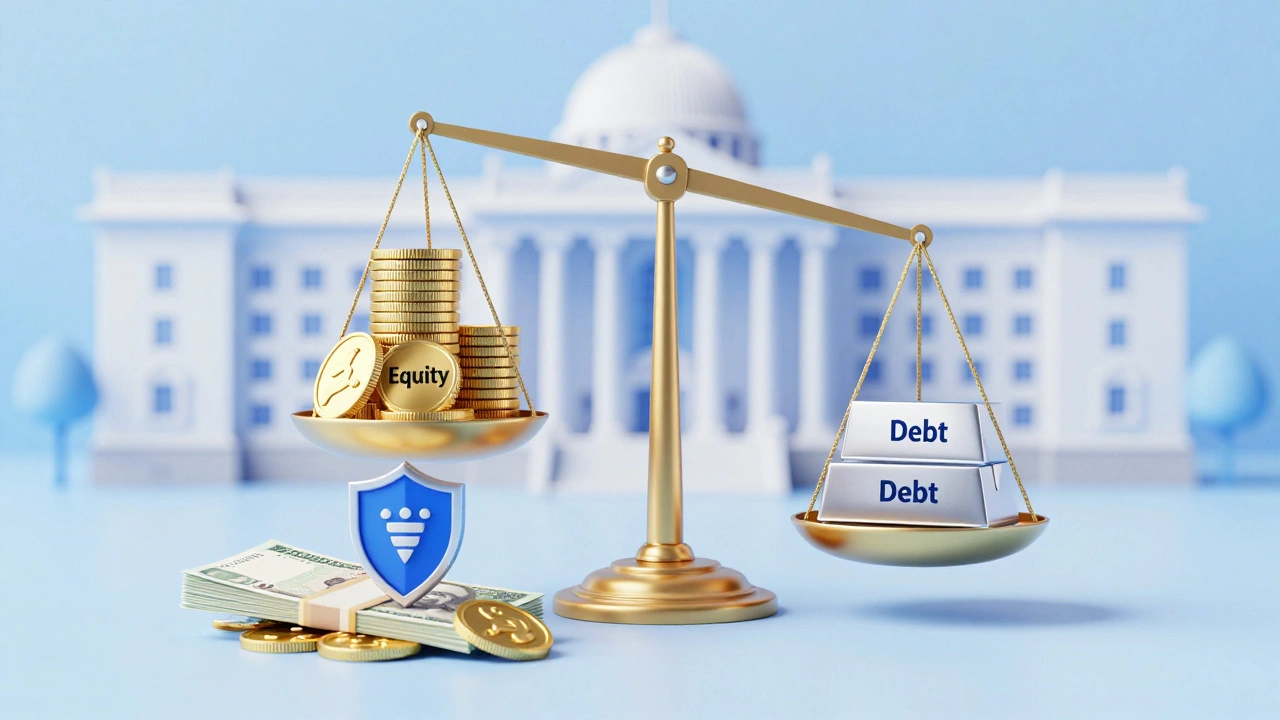
In India, this dynamic is amplified by tax laws. Interest payments on debt are treated as a business expense. This means they reduce your taxable income. If your corporate tax rate is 25%, and your loan interest is 10%, your actual cost is only 7.5%. Dividends paid to equity shareholders, however, come out of post-tax profit. You pay tax on the money first, then give some away. This makes equity significantly more expensive.
| Source of Finance | Average Cost Range (India) | Tax Deductible? | Risk Level |
|---|---|---|---|
| Retained Earnings | 0% (Direct) | N/A | Low |
| Term Loans (Banks/NBFCs) | 8.5% - 14% | Yes | Medium |
| Corporate Bonds/Debentures | 7.5% - 10% | Yes | Medium |
| Equity (Private Placement/IPO) | 12% - 18% (Expected Return) | No | High |
| Venture Capital/Angel Investment | 25% - 40%+ (Valuation Impact) | No | Very High |
Note that these rates fluctuate with the Reserve Bank of India’s (RBI) repo rate. As of 2026, with inflation stabilizing, long-term debt remains a powerful tool for expansion, provided you manage your leverage carefully.
The Role of Government Schemes in Lowering Costs
In India, the government actively tries to make finance cheaper for specific sectors, particularly Small and Medium Enterprises (SMEs) and startups. These schemes effectively subsidize the cost of capital, making certain loans much cheaper than standard market rates.
One major player here is Mudra Loan, which is a loan scheme launched by the Government of India to provide funds to non-corporate, non-farm small/micro enterprises. Under the Pradhan Mantri Mudra Yojana (PMMY), loans up to ₹50 lakh are available. For smaller tickets (Shishu category, up to ₹50,000), interest rates can be surprisingly low, sometimes subsidized through state governments or specific bank initiatives.
Another key entity is the Small Industries Development Bank of India (SIDBI), which is an apex development financial institution established to provide refinance facilities to banks and NBFCs for lending to MSMEs. SIDBI-backed loans often come with lower interest rates because the refinance cost is passed on to the borrower. Additionally, credit guarantee schemes like CGTMSE (Credit Guarantee Fund Trust for Micro and Small Enterprises) allow businesses to get loans without collateral, reducing the risk premium banks charge.
If you run a startup registered under the DPIIT (Department for Promotion of Industry and Internal Trade), you might access funds from the Startup India Seed Fund Scheme (SISFS). While this is technically equity or convertible debt, the valuation terms are often more favorable than private VC funding, effectively lowering the cost of capital.
Internal vs. External: The Retained Earnings Advantage
Let’s go back to retained earnings. If your business generated ₹1 crore in profit last year, and you decide to reinvest ₹50 lakh into buying new machinery, that ₹50 lakh is free. There is no banker to negotiate with, no legal fees for issuing shares, and no interest ticking on a clock.
However, relying solely on internal funds has limits. It slows down growth. You can only expand as fast as you can save. This is where the concept of the Weighted Average Cost of Capital (WACC) comes in. Smart companies mix cheap debt with their own profits to grow faster while keeping the overall cost of money low.
For example, if you use 70% retained earnings and 30% bank loans at 10% interest, your blended cost is very low. But if you use 100% venture capital, your investors will expect a 3x-5x return in 5 years, which translates to an annualized cost of over 25%. That is expensive.
Hidden Costs That Make "Cheap" Finance Expensive
Not all cheap finance stays cheap. You must look beyond the interest rate. Here are the hidden traps in the Indian financial landscape:
- Processing Fees: Banks may offer a low headline interest rate but charge 1-2% processing fees upfront. This increases the effective annual percentage rate (APR).
- Mandatory Insurance: Many lenders tie insurance products (like keyman insurance or property insurance) to the loan. These premiums add to the cost.
- Prepayment Penalties: Some Non-Banking Financial Companies (NBFCs) charge heavy penalties if you pay off the loan early. This locks you into the debt longer than necessary.
- Covenants: Large bank loans often come with strict covenants (rules you must follow, like maintaining a certain current ratio). Breaking these can trigger immediate repayment demands, creating liquidity crises.
When comparing offers, always calculate the All-Inclusive Cost. Add up the interest, fees, insurance, and any mandatory charges. Divide by the net amount received and the tenure. This gives you the true cost.

Which Source is Right for Your Stage?
The "cheapest" source depends heavily on your business lifecycle. A brand-new startup cannot use retained earnings because it has none. A mature manufacturing plant should avoid equity because it’s too expensive relative to its stable cash flows.
- Early Stage (0-2 years): Bootstrapping (personal savings) is the cheapest. After that, Angel Investors or Grants (if eligible) are better than VC due to lower valuation dilution.
- Growth Stage (3-5 years): Venture Capital becomes viable, but look for revenue-based financing or supply chain credit from vendors. Vendor credit is often interest-free if paid within 30-60 days, making it extremely cheap working capital.
- Mature Stage (5+ years): Bank Term Loans and Corporate Bonds are the cheapest. Your credit history allows you to access institutional debt at near-market rates. Retained earnings should fund day-to-day operations.
For instance, a retailer can use trade credit from suppliers. If you buy goods worth ₹10 lakh and pay after 45 days, you’ve effectively taken a short-term loan at 0% interest. This is one of the cheapest forms of working capital finance available in India, often overlooked by small business owners.
Interest Rate Trends in 2026
As we move through 2026, the Indian banking sector is seeing a consolidation of interest rates. The RBI’s monetary policy has aimed to keep inflation in check, which has stabilized long-term lending rates. However, competition among Private Sector Banks and Public Sector Banks (PSBs) means that customers with good CIBIL scores (750+) can negotiate significantly better rates.
Public Sector Banks generally offer lower interest rates on home loans and business term loans compared to Private Banks and NBFCs. If your documentation is complete and your credit score is pristine, starting your search with PSBs like State Bank of India (SBI) or Punjab National Bank (PNB) will likely yield the lowest base rates. Private banks like HDFC or ICICI may offer faster processing and better digital experiences, but often at a slightly higher cost.
Is retained earnings really free?
In terms of direct cash outflow, yes. There are no interest payments or fees. However, there is an "opportunity cost." Shareholders expect a return on their investment. If you retain earnings instead of paying dividends, shareholders assume the company will invest that money wisely to generate returns higher than what they could get in the stock market. If the company fails to do so, the stock price may drop, reflecting the inefficient use of capital.
What is the cheapest loan for a small business in India?
For micro-enterprises, Mudra Loans (Shishu or Kishore categories) are often the cheapest due to government subsidies and lower risk premiums. For slightly larger SMEs, term loans from Public Sector Banks (PSBs) backed by the Credit Guarantee Fund (CGTMSE) offer competitive interest rates, typically ranging from 8.5% to 11%, depending on the borrower's credit profile and the prevailing RBI repo rate.
Why is debt cheaper than equity?
Debt is cheaper for two main reasons. First, interest payments on debt are tax-deductible expenses, which lowers the effective cost for the company. Second, debt holders have a prior claim on assets in case of liquidation, meaning they bear less risk than equity shareholders. Because they bear less risk, lenders accept lower returns (interest) compared to the high returns demanded by equity investors.
Can I use vendor credit as a source of finance?
Yes, and it is one of the cheapest forms of working capital. Vendor credit occurs when you buy inventory or services on credit and pay later (e.g., Net 30 or Net 60 days). During this period, you are using the supplier's money interest-free. To maximize this, maintain strong relationships with suppliers and negotiate extended payment terms without incurring late fees.
How does my CIBIL score affect the cost of finance?
Your CIBIL score directly impacts the interest rate offered. Lenders view higher scores (above 750) as low-risk borrowers. Consequently, they offer lower interest rates. A poor credit score signals higher risk, leading lenders to charge a "risk premium" in the form of higher interest rates, additional processing fees, or requiring collateral. Improving your credit score is one of the fastest ways to reduce the cost of borrowing.