
Home Loan Eligibility Calculator (40 EMI Rule)
Your Financial Details
Eligibility Results
You’ve found the perfect house. The location is great, the layout makes sense, and the price feels right. But when you sit down with a bank manager or an online loan calculator, there’s a number staring back at you that doesn’t quite match your budget. That number is your Equated Monthly Installment (EMI), and it’s governed by a strict limit known as the 40 EMI rule. If you’re applying for a home loan in India, understanding this rule isn’t just helpful-it’s the difference between getting approved and being told to come back with a higher salary.
The Core Concept: What Exactly is the 40 EMI Rule?
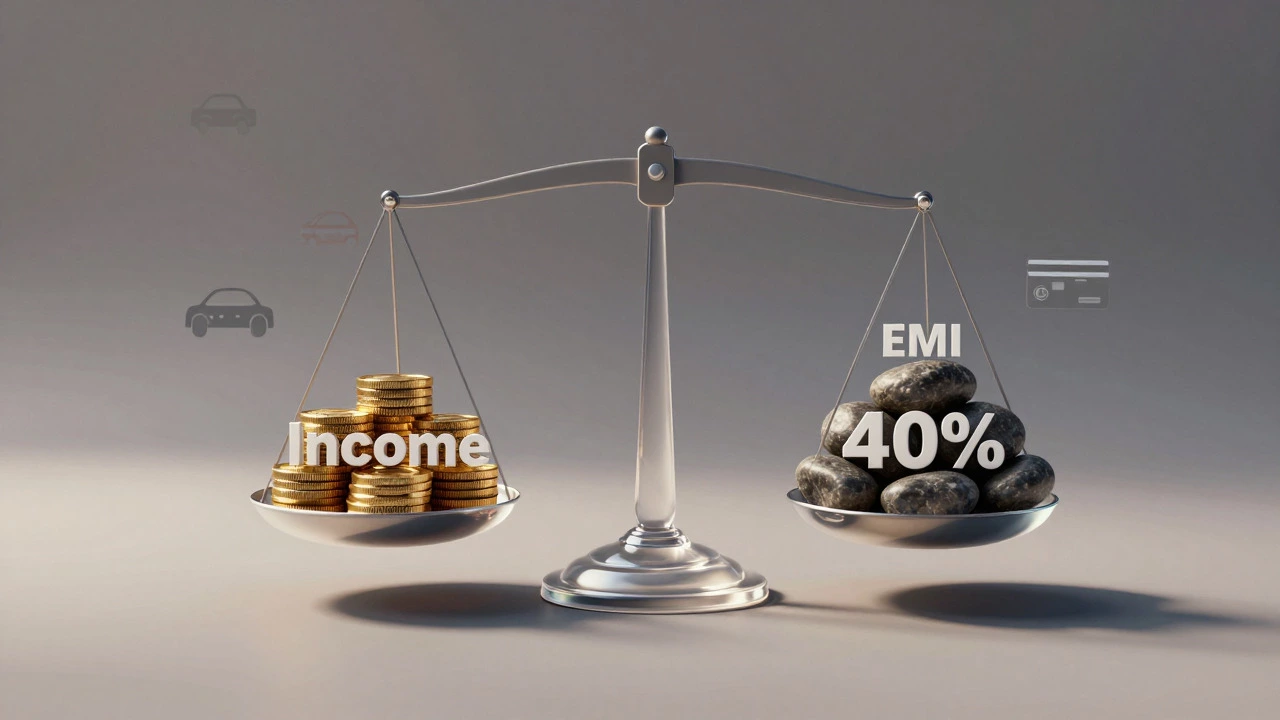
At its simplest, the 40 EMI rule states that your total monthly loan repayments should not exceed 40% of your gross monthly income. This includes your proposed new home loan EMI plus any existing EMIs you are currently paying-car loans, personal loans, credit card minimum dues, and so on. Banks use this metric to assess your repayment capacity. They want to ensure that after paying off your debts, you still have enough money left to live comfortably without financial stress.
Think of it as a safety net for both you and the lender. If you allocate more than 40% of your income to debt, your financial flexibility shrinks dramatically. A medical emergency, a job loss, or even an unexpected car repair could derail your payments. By capping your exposure at 40%, banks mitigate their risk of default while protecting borrowers from over-leveraging themselves.
Does the 40% apply to my net income or gross income?
Banks typically calculate this based on your gross monthly income, which is your salary before tax deductions, provident fund contributions, or other statutory cuts. However, some lenders may look at net take-home pay if they perceive high fixed deductions. Always clarify this with your specific lender during the pre-approval stage.
How the Calculation Works in Real Life
Let’s break down how this works with real numbers. Imagine you earn ₹1,00,000 per month. According to the 40% rule, your maximum allowable total EMI outflow is ₹40,000 (40% of ₹1,00,000). Now, suppose you already have a car loan EMI of ₹10,000 and a personal loan EMI of ₹5,000. Your existing debt burden is ₹15,000.
To find out how much home loan EMI you can afford, subtract your existing EMIs from the maximum allowed amount:
- Maximum Total EMI Allowed: ₹40,000
- Less Existing EMIs: ₹15,000
- Remaining Capacity for Home Loan EMI: ₹25,000
This means the highest monthly installment you can qualify for is ₹25,000. Using a standard home loan calculator with a current interest rate of approximately 8.5% and a tenure of 20 years, an EMI of ₹25,000 would translate to a loan principal of roughly ₹26-27 lakhs. If you need a larger loan, say ₹50 lakhs, your EMI would be around ₹43,000, which exceeds your remaining capacity. In this scenario, you’d either need to extend the tenure, increase your down payment, or add a co-applicant with additional income.
Why Do Banks Stick to This Percentage?
Banks don’t pull the 40% figure out of thin air. It’s rooted in regulatory guidelines and internal risk models set by bodies like the Reserve Bank of India (RBI). The goal is to maintain a healthy Debt-to-Income (DTI) ratio. A DTI ratio above 40-50% signals high financial stress. When households spend too much on debt servicing, consumer spending drops, and the likelihood of missed payments rises.
Moreover, life happens. Salaries might stagnate, inflation might rise, or family responsibilities might increase. The 40% buffer ensures you retain at least 60% of your income for living expenses, savings, investments, and emergencies. It’s a pragmatic approach to long-term financial stability rather than a short-term approval tactic.
Can You Get Around the 40 EMI Rule?
While the 40% rule is a strong guideline, it’s not always an absolute wall. Some private banks and housing finance companies (HFCs) may stretch this limit to 50% or even 60% under specific conditions. Here’s how you might negotiate a higher limit:
- Excellent Credit Score: A CIBIL score above 780 shows you’re a low-risk borrower. Lenders are more willing to offer flexibility to those with proven track records of timely repayments.
- Stable Employment History: If you’ve been with the same employer for five+ years or work in a stable sector like government or IT, banks view your income as secure.
- Additional Income Sources: Rental income, freelance earnings, or dividends can sometimes be factored into your gross income, though banks usually apply a "haircut" (discount) to these figures, counting only 70-80% of rental income, for example.
- Co-Applicants: Adding a spouse, parent, or sibling as a co-applicant combines incomes and EMIs. If your partner earns ₹50,000 with no existing loans, their full 40% capacity (₹20,000) adds to yours, significantly boosting your loan eligibility.
However, stretching beyond 40% should be done cautiously. Just because you *can* borrow more doesn’t mean you *should*. Higher EMIs mean less cash flow for daily life and retirement planning.
Strategies to Maximize Your Home Loan Eligibility
If the 40% cap is holding you back from your dream home, here are practical steps to improve your position:
1. Clear Small Loans First
Before applying for a home loan, try to close small personal loans or credit card balances. Even a ₹5,000 monthly EMI reduction frees up that amount for your home loan capacity. Closing a loan also improves your credit score by lowering your utilization ratio.
2. Optimize Your Credit Card Usage
Banks look at your credit card outstanding balance as part of your debt load. Keep your credit card utilization below 30% of your limit. Paying off the full statement balance each month prevents interest accumulation and shows responsible credit management.
3. Increase Your Down Payment
A larger down payment reduces the loan amount you need. If you need ₹50 lakhs but put down ₹10 lakhs extra, you only borrow ₹40 lakhs. This lowers your EMI, making it easier to fit within the 40% rule without needing a higher income.
4. Extend the Tenure (With Caution)
Increasing the loan tenure from 20 to 25 years reduces your monthly EMI. For example, a ₹30 lakh loan at 8.5% has an EMI of ₹26,000 for 20 years but only ₹23,500 for 25 years. While this helps you clear the 40% hurdle, remember that longer tenures mean paying significantly more interest over time. Calculate the total cost before deciding.
The Hidden Costs Beyond the EMI
When focusing on the 40 EMI rule, it’s easy to forget about other costs associated with buying a home. Property registration charges, stamp duty, legal fees, and brokerage can add up to 5-10% of the property value. Additionally, once you own the home, you’ll face maintenance fees, property taxes, and insurance premiums.
Financial experts recommend keeping your total housing-related costs (EMI + maintenance + taxes) under 30-35% of your income. This leaves room for lifestyle expenses and future investments. Ignoring these hidden costs can lead to a situation where you technically qualify for the loan but struggle to afford the home itself.

Comparing Lender Policies: Public vs. Private Banks
Not all lenders apply the 40% rule uniformly. Understanding the differences can help you choose the right institution:
| Lender Type | Typical EMI Cap | Flexibility | Processing Speed | Best For |
|---|---|---|---|---|
| Public Sector Banks | Strict 40-50% | Low | Slower (2-4 weeks) | Government employees, stable salaried individuals |
| Private Sector Banks | 40-60% | Medium-High | Faster (1-2 weeks) | High-income earners, professionals with good credit scores |
| Housing Finance Companies (HFCs) | Up to 60-70% | High | Versatile (1-3 weeks) | Self-employed individuals, those with complex income structures |
If you’re stuck at the 40% limit with a public sector bank, switching to a private bank or HFC might unlock higher eligibility. However, compare interest rates carefully, as HFCs often charge slightly higher rates than public banks.
Common Mistakes Borrowers Make
Many first-time homebuyers fall into traps that reduce their chances of approval or lead to financial strain later:
- Ignoring Existing Debts: Assuming the bank will only look at the new home loan EMI. Remember, all EMIs count toward the 40% cap.
- Overestimating Future Income: Basing your loan application on expected raises or bonuses that haven’t happened yet. Banks prefer proven, consistent income.
- Neglecting Credit Health: Applying for multiple loans simultaneously can spike your credit inquiries, temporarily lowering your score and affecting eligibility.
- Choosing the Longest Tenure Blindly: While it lowers EMI, it increases total interest paid. Balance affordability with total cost.
Final Thoughts: Balancing Ambition with Reality
The 40 EMI rule isn’t designed to stop you from buying a home; it’s designed to ensure you can keep it. By understanding how banks calculate your eligibility, you can plan smarter. Whether you need to clear old debts, add a co-applicant, or adjust your down payment, there are ways to work within this framework. Don’t let the rule dictate your dreams-use it as a tool to build a sustainable financial future. Start by calculating your current DTI ratio, explore options with different lenders, and never sign a loan agreement that leaves you financially breathless.
What happens if I breach the 40 EMI rule?
If your total EMIs exceed 40-50% of your income, most traditional banks will reject your application unless you provide strong compensating factors like a very high credit score or substantial collateral. You may need to seek approval from Housing Finance Companies (HFCs) that offer more flexible terms, though often at higher interest rates.
Does the 40% rule include credit card minimum dues?
Yes, banks consider the minimum monthly payment required on your credit cards as part of your existing debt obligations. To maximize eligibility, pay off credit card balances fully before applying for a home loan.
Can self-employed individuals use the 40 EMI rule?
Yes, but the calculation is based on average net profit from your Income Tax Returns (ITR) over the last 2-3 years. Self-employed applicants often face stricter scrutiny, and banks may apply a lower multiplier to their income compared to salaried individuals.
How does adding a co-applicant change the 40% calculation?
Adding a co-applicant combines both incomes and deducts both sets of existing EMIs. For example, if you earn ₹1L and your spouse earns ₹50k, the bank calculates 40% of the combined ₹1.5L income (₹60k max EMI), then subtracts any joint or individual existing EMIs. This significantly boosts your borrowing power.
Is the 40 EMI rule mandatory across all Indian banks?
It is a widely accepted industry standard guided by RBI norms, but individual banks have discretion. Public sector banks tend to be stricter, while private banks and HFCs may allow up to 60% for premium customers or those with exceptional credit profiles.