
Investment Portfolio Allocation Calculator
Your Profile
Allocation Breakdown
-
Equity55%
-
Debt35%
-
Real Estate5%
-
Alternatives5%
Visual Allocation
Quick Tips
- Start with an emergency fund (6 months expenses) before investing.
- Rebalance your portfolio once a year to maintain target allocations.
- Consider SIPs for equity investments to average out market volatility.
Money sitting in a savings account is slowly losing its value. With inflation hovering around 6% to 7% in India, your hard-earned cash buys less every year if it isn't working for you. You don't need to be a Wall Street wizard to fix this. You just need to know where to put your money.
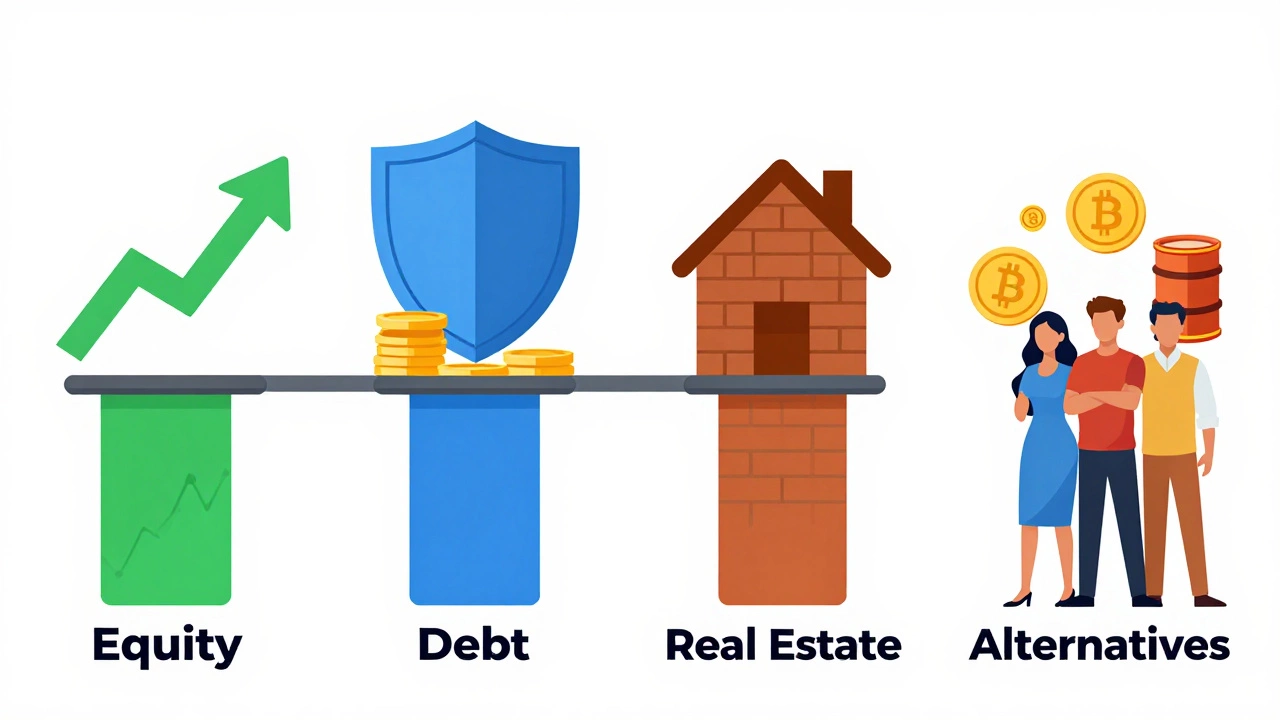
Many people think investing means buying stocks or betting on crypto. That’s only part of the picture. In India, the financial landscape is diverse. To build wealth that actually outpaces inflation and secures your future, you need to understand the four main pillars of investing. These aren't just categories; they are tools for different jobs-like saving for retirement, buying a home, or building emergency funds.
Let’s break down the four types of investments in India: Equity, Debt, Real Estate, and Alternatives. We’ll look at how they work, who they are for, and how to mix them so you sleep well at night.
1. Equity Investments: The Growth Engine
When you hear "investing," most people think of equity. This is where you buy a small piece of a business. If the company grows, your share price goes up. It’s the highest-risk category, but also the one with the highest potential reward. Historically, the Indian stock market has delivered returns of roughly 12% to 15% annually over long periods (10+ years).
You don’t have to pick individual stocks. In fact, most beginners shouldn’t. Instead, you can use:
- Direct Stocks: Buying shares of specific companies like Reliance Industries or HDFC Bank directly via a demat account.
- Mutual Funds: Professional managers pool money from thousands of investors to buy a diversified portfolio. Index funds tracking the Nifty 50 are popular because they have low fees.
- ETFs (Exchange Traded Funds): Similar to mutual funds but traded on the stock exchange like a single share.
Equity is best for goals that are far away. Think retirement at age 60, or funding your child’s education in 15 years. Why? Because the market crashes sometimes. If you need the money next year, you might get caught in a dip. But if you hold for a decade, history shows the market almost always recovers and grows.
Pro Tip: Use Systematic Investment Plans (SIPs). Investing a fixed amount every month averages out your cost over time, removing the stress of trying to time the market.
2. Debt Investments: The Stability Anchor
If equity is the engine, debt is the brakes and steering wheel. It keeps you steady when things get bumpy. Debt instruments involve lending your money to someone else-the government or a company-and getting paid back with interest. The risk is lower than equity, and so are the returns. Expect 6% to 9% annual returns depending on the instrument and your credit profile.
Here are the common debt options in India:
- Government Securities (G-Secs): Lending money to the Government of India. Considered virtually risk-free.
- Fixed Deposits (FDs): Locking money in a bank for a fixed term. Safe, predictable, but often taxed heavily.
- Corporate Bonds: Lending to private companies. Higher risk than G-Secs, but higher interest rates.
- Public Provident Fund (PPF): A government-backed scheme with tax benefits under Section 80C. Returns are currently around 7.1% (as of 2025-26 fiscal reviews).
Debt is crucial for short-term goals (buying a car in 3 years) and for balancing your portfolio. When the stock market falls, your debt holdings usually stay stable or grow slightly, cushioning the blow. Financial advisors often suggest a simple rule: subtract your age from 100 to find your equity percentage. If you’re 30, keep 70% in equity and 30% in debt. As you age, shift more into debt.
3. Real Estate: The Tangible Asset
For decades, Indians have believed that land never loses value. And mostly, they were right. Real estate is a favorite because it’s tangible-you can touch it. Plus, it offers two ways to make money: capital appreciation (the price goes up) and rental yield (someone pays you rent).
However, traditional real estate is illiquid. You can’t sell half your house quickly if you need cash. It also requires significant upfront capital. Enter REITs (Real Estate Investment Trusts). REITs allow you to invest in large commercial properties (like malls or office parks) with as little as ₹500. They trade on the stock exchange, making them liquid and accessible.
Consider real estate if:
- You want a hedge against inflation (property prices often rise with inflation).
- You prefer assets you can physically see.
- You have a long horizon (5-10 years) and can handle the hassle of tenants or maintenance (if owning directly).
In major cities like Mumbai, Bangalore, and Delhi-NCR, property values have grown significantly over the last decade. But remember, location is everything. A bad location can mean zero growth for years.
4. Alternative Investments: The Diversifiers
This category is the "catch-all" for anything that isn’t stocks, bonds, or bricks. Alternatives serve a specific purpose: they don’t move in sync with the stock market. When equities crash, these assets might hold steady or even rise, reducing overall portfolio volatility.
The most popular alternatives in India include:
- Gold: Culturally deeply rooted in India. You can buy physical gold, Gold ETFs, or Sovereign Gold Bonds (SGBs). SGBs are particularly smart because the government pays you 2.5% interest per year on top of any price appreciation, and the capital gains are tax-free if held to maturity.
- Cryptocurrency: High risk, high reward. Bitcoin and Ethereum have seen massive swings. Treat this as speculative money-only invest what you can afford to lose entirely.
- Commodities: Oil, silver, agricultural products. Usually accessed via futures contracts or commodity ETFs.
- Private Equity/Venture Capital: Investing in startups before they go public. High barrier to entry, but potentially life-changing returns if you hit a unicorn.
Financial experts generally recommend keeping alternatives between 5% and 10% of your total portfolio. Gold, specifically, is often suggested at 5-10% as a safe haven during economic uncertainty.

How to Choose: Building Your Mix
No single type of investment is "best." The best strategy depends on your age, income, risk tolerance, and goals. Here is a quick guide to matching investments to your life stage:
| Profile | Equity | Debt | Real Estate | Alternatives |
|---|---|---|---|---|
| Aggressive (Age 20-35) | 70-80% | 10-20% | 0-10% | 5-10% |
| Moderate (Age 35-50) | 50-60% | 30-40% | 5-10% | 5-10% |
| Conservative (Age 50+) | 20-30% | 60-70% | 5-10% | 5-10% |
Notice how equity drops as you get older? That’s because you have less time to recover from market crashes. Debt becomes more important to preserve your capital. Real estate and alternatives remain relatively constant as diversifiers.
Start with an emergency fund first. Keep 6 months of expenses in a liquid debt instrument like a Fixed Deposit or Liquid Mutual Fund. Only then should you start allocating to these four buckets. Rebalance once a year. If equity surges and now makes up 80% of your portfolio instead of 70%, sell some profits and move them to debt. This simple act forces you to "buy low and sell high."
Frequently Asked Questions
Which type of investment is best for beginners in India?
For beginners, Index Mutual Funds (Equity) and Public Provident Fund (PPF) (Debt) are the best starting points. Index funds offer broad market exposure with low fees, while PPF provides safety, tax benefits, and guaranteed returns. Avoid direct stock picking or complex derivatives until you understand the basics.
Is real estate still a good investment in 2026?
Yes, but with caveats. Physical real estate remains a strong hedge against inflation in prime locations. However, it is illiquid and requires high capital. For smaller investors, REITs offer a more accessible way to benefit from commercial real estate growth without the hassle of managing tenants.
Should I invest in gold or Sovereign Gold Bonds?
Sovereign Gold Bonds (SGBs) are generally superior for pure investment purposes. Unlike physical gold, SGBs pay 2.5% annual interest and have tax-free capital gains if held to maturity (8 years). Physical gold incurs making charges and storage risks, though it holds cultural and ceremonial value.
How much of my portfolio should be in alternative investments?
Most financial advisors recommend keeping alternative investments between 5% and 10% of your total portfolio. This includes gold, cryptocurrencies, and commodities. This allocation provides diversification benefits without exposing you to excessive volatility or complexity.
What is the safest investment option in India?
The safest investments are those backed by the government. Government Securities (G-Secs), Public Provident Fund (PPF), and National Savings Certificate (NSC) carry virtually zero default risk. Fixed Deposits in top-tier banks are also considered very safe due to deposit insurance up to ₹5 lakh per depositor per bank.